
A government panel just made a big decision about peptides, the trendy injections that promise everything from faster muscle recovery to better sleep. Over two days this week, the panel voted to open the door for pharmacies to start making six out of seven of these peptides. This happened even though the Food and Drug Administration’s (FDA) own scientists warned there isn’t enough proof they are safe or that they work.
Here’s what happened, who made the call, and why so many people are watching closely.
What Are Peptides, and Why Do People Want Them?
Peptides are short chains of amino acids, smaller than proteins, but similar in some ways. Some peptides occur naturally in the body, like insulin. Others are made in labs and sold as treatments for things like joint pain, weight loss, wrinkles, and poor sleep.
In the last few years, peptides have become hugely popular, especially online. Social media influencers talk them up as secret tools for staying young, building muscle, or healing faster. This buzz took off around the same time compounded weight-loss drugs, like copycat versions of Ozempic, became mainstream.
The problem is that most peptides being sold today are not approved by the FDA. Back in 2023, the FDA banned pharmacies from making 19 different peptides, saying they could pose safety risks. Since then, many people have kept buying them anyway, often from overseas sellers online who label the products “for research use only” as a loophole. This is sometimes called the peptide gray market.
Why Are These Peptides Are Becoming a Popular Discussion?
In 2023, the seven peptides under discussion, BPC-157, KPV, TB-500, MOTS-C, emideltide, Epitalon, and Semax; were among a group of substances that the FDA determined could present significant safety risks when used in compounded drugs. The agency subsequently restricted their use in compounding under the applicable regulatory framework.
Compounding pharmacies prepare customized medications for individual patients, typically based on a prescription or other legally permitted patient-specific need. Traditional 503A compounding pharmacies are primarily overseen by state boards of pharmacy, although the FDA also has authority over certain aspects of their operations. This differs from the regulatory framework governing pharmaceutical manufacturers, which must comply with extensive federal requirements for the development, approval, manufacturing, and marketing of FDA-approved drugs.
Since those 2023 restrictions, some consumers have turned to alternative sources, including suppliers based in China, which peptide advocates say can expose them to additional concerns about product quality, purity, and safety. In testimony on July 23, Dr. Anant Vinjamoori, chief medical officer at the telehealth company Hims & Hers, said that a colleague had recently sent him a photo of a bodega in Queens selling peptides.
“This is the real alternative to FDA’s permission of legitimate pharmacies to compound peptides in controlled conditions,” he said.
Both Hims & Hers and Noom, a weight-management company, advocated before the committee’s vote for certain peptides to be permitted for compounding by pharmacies.
Why Is an FDA Committee Meeting About Peptides?
The FDA held a committee meeting on July 23 and 24 to discuss whether seven widely used peptides should be added to the 503A bulk drug substances list, which can allow certain substances to be used in compounded preparations by compounding pharmacies under specific conditions. Several voting members of the committee have consulting or employment relationships with companies that could potentially benefit from the ability to compound or market peptide products. FDA advisory committees are typically made up of academics, researchers, and other experts in relevant scientific and medical fields.
The committee’s recommendation is not binding. Any addition to the list would still need to go through a formal public rulemaking process.
However, experts have raised concerns about the process because adding substances to the 503A list could facilitate broader access through compounding pharmacies without those substances undergoing the same FDA approval process required for commercially manufactured drugs. Most medicines are instead FDA-approved and manufactured by pharmaceutical companies under the FDA’s regulatory framework.
The distinction is important: inclusion on the 503A list would not itself constitute FDA approval of a peptide. Rather, it could create a regulatory pathway for certain compounded preparations to be made under specific conditions.
The Decisions of the Panel and What It Voted On?
The group making this decision is called the Pharmacy Compounding Advisory Committee, or PCAC. It’s an advisory panel to the FDA. Its job is to recommend which drug ingredients “compounding pharmacies” are allowed to prepare. Compounding pharmacies are special pharmacies that mix custom medicines for individual patients with a doctor’s prescription. They don’t go through the same strict approval process as regular drug manufacturers.
The panel met over two days, Thursday, July 23, 2026 and Friday, July 24, 2026, at the FDA’s White Oak campus in Maryland, to review seven peptides for a list called the 503A Bulks List, basically the list of ingredients compounding pharmacies are allowed to use.
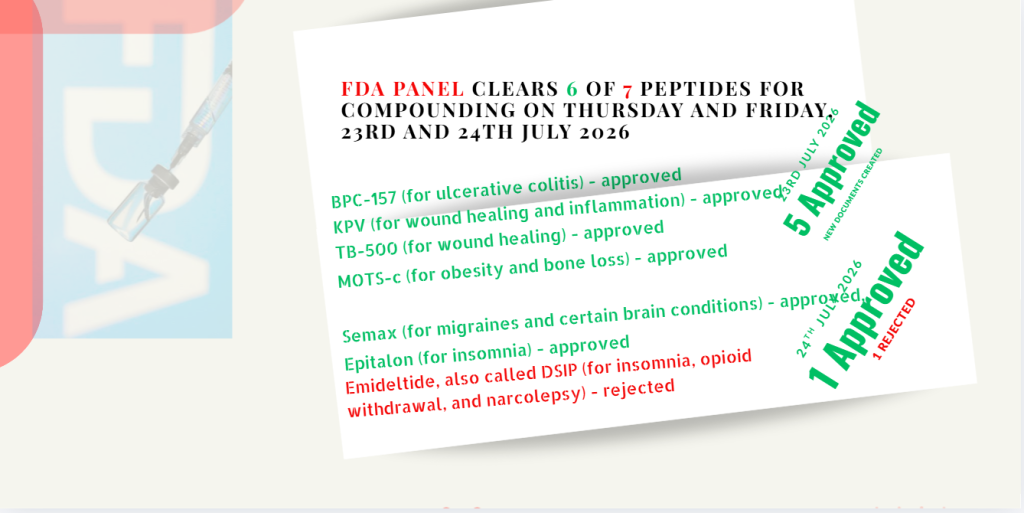
On the first day, Thursday, July 23, the panel voted on four peptides:
- BPC-157 (for ulcerative colitis) – approved, 8 yes, 6 no, 1 not voting
- KPV (for wound healing and inflammation) – approved, 8-6-1
- TB-500 (for wound healing) – approved, 8-6-1
- MOTS-c (for obesity and bone loss) – approved, 7 yes, 5 no, 2 not voting
On the second day, Friday, July 24, the panel voted on the last three:
- Semax (for migraines and certain brain conditions) – approved, 8 yes, 5 no, 1 not voting
- Epitalon (for insomnia) – approved, 7 yes, 4 no, 1 not voting
Just one rejected!
- Emideltide, also called DSIP (for insomnia, opioid withdrawal, and narcolepsy) – rejected, 6 yes, 7 no, 1 not voting
So six out of seven peptides got a thumbs-up. Emideltide was the only one voted down, and it was close. Committee members who voted no on it said there just wasn’t enough evidence that it works or is safe.
It’s worth being clear about what these votes actually mean: nothing changes right away. The FDA is not required to follow the panel’s advice, though it usually does. Before compounding pharmacies could legally make any of these peptides, the FDA has to go through a formal rule-making process, which usually takes many months, sometimes close to a year or longer.
Who Sits on This Panel – and Why That’s the Big Controversy
The most talked-about part of this story isn’t really the votes themselves. It’s who was doing the voting.
Just weeks before the meeting, on June 29, the FDA announced a big shake-up of the committee. Eight new members were added. According to reporting on the appointments, nearly all of these new members have some financial connection to the peptide business – they run clinics that sell peptide treatments, work for companies that promote them, or advise businesses in that space.
A few examples of members and how they explained their votes:
- Dr. Asare Christian runs a clinic in Pennsylvania that advertises peptide treatments and hormone therapy. He voted yes, saying the goal was about patient access to treatment options.
- Dr. Haleem Mohammed, chief medical officer at a men’s health clinic chain in Florida, voted yes on BPC-157. He said he worried that voting no would push more people toward buying unsafe products online instead.
- David Pope, chief pharmacy officer at a compounding pharmacy company, voted yes for most peptides, saying it puts the decision back in the hands of patients, doctors, and pharmacists. Notably, he was one of the members who later voted no on emideltide, showing the panel wasn’t just rubber-stamping everything.
- Melissa Loseke, another panel member, described a patient who brought her a “research-grade” peptide bought online that turned out to be contaminated with MDMA and ecstasy. She used this as an argument for adding peptides to the approved list – the thinking being that legal, regulated versions would be safer than gray-market ones.
- On the other side, Dr. Elizabeth Rebello, a professor at MD Anderson Cancer Center, voted no on several peptides, pointing to a lack of solid clinical trial data.
- Dr. Kevin Zacharoff, an anesthesiologist at Stony Brook University’s medical school, also raised safety concerns during the discussions.
Critics, including outside scientists, say stacking the panel this way created an obvious conflict of interest. Paul Knoepfler, a cell biology professor at UC Davis, questioned how members who could financially benefit from approval were allowed to vote at all.
The Department of Health and Human Services (HHS) has defended the process, saying every committee member went through the same ethics review required of anyone appointed to an FDA advisory panel, and that any candidates who couldn’t meet those requirements were removed before the vote.
Where Health Secretary RFK Jr. Fits In?
This whole story connects to Health Secretary Robert F. Kennedy Jr., who oversees the FDA. Kennedy has said publicly that he is a supporter of compounded peptides and wants restrictions loosened. Reporting connects the reshaped panel and this week’s favorable votes directly to his broader push to make these treatments more available to the public. He has called himself, in his own words, “a big fan” of them.
Why FDA’s Own Scientists Are Worried
Before the meeting, FDA staff scientists wrote briefing documents recommending against adding any of the seven peptides to the compounding list. Their concerns weren’t just about missing efficacy data – they also raised a more basic problem: it’s often unclear exactly what’s in these products.
One staff presenter explained that the FDA has found many different products all being sold under the same name, like “BPC-157,” that actually contain different active ingredients. Without a standard, agreed-upon chemical definition, it’s hard to guarantee what patients are actually getting or how safe it is long-term.
Specific safety flags raised in FDA’s briefing materials included reports of adverse events linked to BPC-157 injections, questions about cancer risk tied to how epitalon works in the body, and concerns that semax could increase bleeding risk or interact with other stimulant drugs. For emideltide, the concern was that the substance itself wasn’t well-characterized enough to know what’s really being made.
One committee member who voted no, referencing the existing data on BPC-157, said the evidence so far suggests it may work no better than a placebo, adding that serious risks like liver damage might not even show up through patient self-reporting.
What Happens Next
For now, none of this is legally binding. The votes are recommendations only. The FDA still has to decide whether to accept them, and if it does, it must go through a formal public rule-making process – including a public comment period – before compounding pharmacies can legally start making these peptides. That process commonly takes many months to more than a year.
The FDA has also indicated a second round of reviews is expected before the end of February 2027, covering five additional peptides: LL-37, GHK-Cu, Dihexa, Melanotan II, and PEG-MGF.
For everyday consumers, the practical takeaway right now is simple: nothing has changed yet. Peptides that were restricted before this vote are still restricted. But this week’s decision is being seen as a major signal of where U.S. drug policy on peptides may be headed next.
More About FDA Pharmacy Compounding Advisory Committee Members
1. Dr. Asare B. Christian
Current identity: Physician, regenerative-medicine practitioner, and founder/medical director of Aether Medicine in Wayne, Pennsylvania.
Known professional background: The FDA lists him as Asare B. Christian, MD, MPH, ABPMR, ABAARM. His listed area of expertise is Cellular Medicine and Regenerative Therapies, and he serves as founder and medical director of Aether Medicine.
His public comments during the peptide discussion reflected a patient-access perspective. Reporting on the meeting quoted Christian as saying that his view was shaped by “the lens of the patient in front of me.”
Birth country: I have not found a sufficiently reliable public source confirming his birthplace or country of birth.
Education: His professional credentials establish an MD and MPH, but I would want to verify the exact institutions and dates from an official biography or CV before publishing them.
Professional profile: Christian appears to be one of the panel members whose clinical work is directly connected to regenerative medicine and peptide-related treatment. That background is relevant to understanding his position, but it should not automatically be treated as proof that his vote was improper or financially motivated.
2. Dr. Haleem Mohammed
Current identity: Physician and medical executive associated with Gameday Men’s Health, a national men’s-health clinic network.
Reporting described Mohammed as operating clinics in Florida that offer services involving peptides, vitamins, testosterone, and weight-management medications.
Position on the peptides: Mohammed voted in favor of BPC-157. His stated concern was that rejecting legal compounding could push patients toward products purchased through less-regulated online sources.
Birth country: I have not found a reliable source confirming his country of birth.
Education: Public reporting identifies him as an MD and MBA, but his full educational history should be verified from an official professional biography before publication.
Why he matters to the debate: Mohammed represents a particularly important perspective because his professional environment is directly connected to the commercial delivery of men’s-health and wellness treatments. At the same time, his argument was not simply “peptides are safe”; rather, the argument was that unregulated alternatives may create a different and potentially greater safety problem.
3. David Pope
Current identity: Chief Pharmacy Officer at XiFin Pharmacy Solutions.
Pope became particularly notable during the meeting because he did not vote identically on every peptide. He supported the earlier peptides but later joined the opposition to emideltide. Reporting described his concern as involving the peptide’s potentially dangerous downstream consequences.
A report on the earlier vote quoted Pope as saying that the decision should be placed back in the hands of patients, physicians, and pharmacists.
Birth country: I have not found reliable public information confirming his birthplace.
Education: His professional title indicates a senior pharmacy background, but I would not state specific degrees, schools, or dates without verifying them through an official biography or professional record.
Why he matters: Pope is arguably one of the most interesting members from an analytical perspective. His voting pattern demonstrates that the panel was not necessarily divided into two completely fixed camps. He supported some peptides but opposed emideltide, suggesting that individual members were making substance-specific judgments rather than automatically voting for or against all seven compounds.
4. Dr. Melissa Loseke
Current identity: Osteopathic physician, regenerative-medicine practitioner, and founder/medical director of the Re-New Institute in Nebraska.
Public reporting describes Loseke as a physician whose practice includes peptide-related treatment and focuses on areas such as aging, fatigue, and chronic imbalance.
During the meeting, she described a patient who had obtained a product labeled as a “research-grade” peptide online. According to her testimony, the product was found to be contaminated with MDMA and ecstasy. She used the incident to argue that an illegal or poorly regulated supply chain could itself create serious safety risks.
Birth country: I have not found reliable public information confirming her country of birth.
Education: She is a DO, but her full educational history should be verified from an official biography before publication.
Why she matters: Loseke’s position represents one of the central arguments made by proponents of allowing certain peptides to be compounded:
The choice is not necessarily between “safe FDA-approved medicine” and “unsafe compounded medicine.” In practice, some consumers may already be purchasing products from poorly regulated sources.
Her argument was that a legal, controlled compounding system could potentially provide better quality controls than the gray market. However, that argument does not establish that the peptides themselves have been proven safe or effective.
5. Dr. Elizabeth Rebello
Of the people listed, Rebello has one of the strongest publicly documented academic and institutional profiles.
Current identity: Elizabeth Rebello, M.D., FASA, professor and executive director at The University of Texas MD Anderson Cancer Center.
Her official MD Anderson biography lists her as:
- Professor of Anesthesiology and Perioperative Medicine
- Executive Director of Anesthesiology, Critical Care, and Pain Medicine, Cancer Network
- Executive Director of the Cancer Network’s Anesthesiology, Critical Care and Pain Medicine program
- Member of the FDA Pharmacy Compounding Advisory Committee
Education
Her official biography states that she:
- Earned a Bachelor of Science in Pharmacy from the University of Houston in 1994
- Earned her MD from the University of Texas School of Medicine, San Antonio, in 2002
- Completed clinical training and held professional roles in pharmacy and anesthesiology.
Birth country: I have not found reliable public information confirming her country of birth. Her publicly documented education and career are in the United States, but that does not establish where she was born.
Professional experience
Before and alongside her academic career, Rebello worked as a pharmacist and anesthesiologist. Her official biography also lists experience with the United States Pharmacopeia and the Texas Medical Board.
Position on the peptides
Rebello was one of the more skeptical voices on the panel. Reporting quoted her as expressing concern that the process could be responding to market demand rather than solid scientific evidence.
Her position is important because it represents the argument that patient demand and the existence of a gray market should not substitute for evidence demonstrating safety, quality, and effectiveness.
6. Dr. Kevin Zacharoff
Current identity: Clinical Assistant Professor at Stony Brook University’s Renaissance School of Medicine and a physician specializing in anesthesiology, pain medicine, and substance-use issues.
Stony Brook’s official biography describes him as:
- A clinical assistant professor
- Course director for Pain and Addiction
- A consultant to the FDA’s Anesthetic and Analgesic Drug Products Advisory Committee
- A board-certified anesthesiologist
- A physician with more than 30 years of clinical experience in anesthesiology and pain medicine.
Education and training
His official biography lists:
- MD: Ross University School of Medicine
- Residency: Westchester Medical Center
Birth country: I have not found reliable public information confirming his country of birth.
Professional background
Zacharoff’s expertise is particularly relevant to the peptide debate because his professional work has focused on pain management, addiction, and the risks associated with medical treatments. His perspective therefore comes from a different background than that of a peptide-focused wellness practitioner.
A crucial correction to the way this section should be framed
I would not describe the group simply as:
“the doctors who voted for peptides” versus “the doctors who voted against peptides.”
That would oversimplify the meeting.
A more accurate description is:
The panel contained several different professional backgrounds
Regenerative medicine and peptide-related clinical practice
- Asare Christian
- Melissa Loseke
- Haleem Mohammed
Pharmacy and compounding
- David Pope
Academic medicine and research-oriented clinical practice
- Elizabeth Rebello
- Kevin Zacharoff
The votes also did not always follow a perfect professional split. For example, David Pope supported several peptides but later voted against emideltide, while the final votes differed by substance. The meeting ultimately recommended several peptides for the 503A bulks-list pathway but rejected emideltide; the recommendations are advisory rather than final FDA approvals.
What Is the FDA Pharmacy Compounding Advisory Committee?
The Pharmacy Compounding Advisory Committee (PCAC) is an expert advisory committee that helps the U.S. Food and Drug Administration evaluate scientific, technical, and medical issues related to the compounding of human drugs. FDA records document PCAC meetings as early as October 14–16, 1998, followed by meetings in 1999 and 2000. Its modern legal authority is connected to Sections 503A and 503B of the Federal Food, Drug, and Cosmetic Act, which establish important rules for drug compounding.
Why Does It Matter?
The committee matters because its recommendations can influence which substances may be used in certain compounded drugs. For example, when the FDA considers whether a substance should be included on the Section 503A Bulk Drug Substances List, the committee may review available scientific, medical, and technical evidence and provide a recommendation. This is particularly important for substances that are not FDA-approved drugs, because the committee’s advice can influence whether compounding pharmacies may legally use them under the relevant compounding framework. However, a committee recommendation is not the same as FDA approval. The FDA retains the final regulatory authority.
How Many Approvals Have They Made?
Technically, the committee itself has made zero FDA approvals. It is an advisory body, not an approval authority. Its members vote on recommendations, and the FDA may consider those recommendations when making its own regulatory decisions. In the July 23–24, 2026 meeting, for example, the committee voted on whether certain bulk drug substances should be recommended for inclusion on the Section 503A list. Those votes were non-binding recommendations, not FDA approvals. The FDA must still make the final regulatory decision and follow the applicable rulemaking process.
Who Do They Work Under?
The committee ultimately provides advice to the Commissioner of Food and Drugs, the head of the FDA. The committee is supported administratively by the FDA, including the Office of the Commissioner, Principal Deputy Commissioner, and relevant FDA centers and offices. The current FDA structure identifies the committee’s Designated Federal Officer within the FDA’s Office of Executive Programs and Center for Drug Evaluation and Research (CDER). The committee therefore does not operate as an independent regulator: its role is to provide expert advice to the FDA, while the FDA retains the authority to make the final regulatory decisions.
