
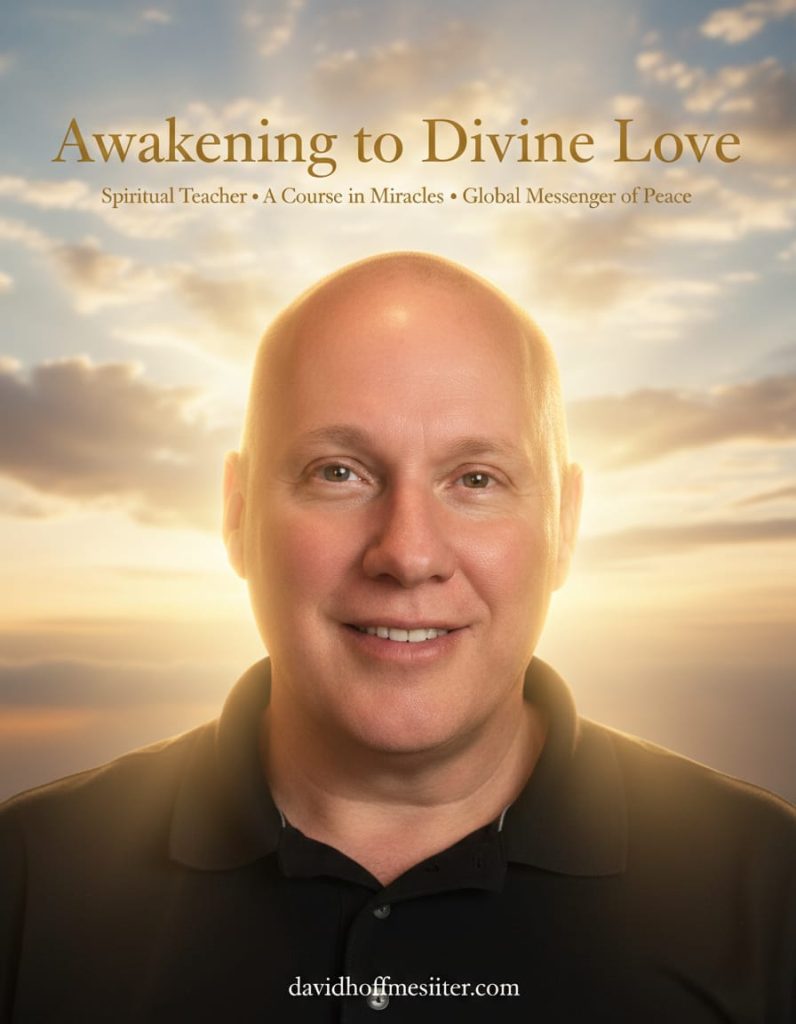
When people search for david hoffmeister wikipedia, they are often looking for structured biographical information—background, affiliations, and core teachings. While such summaries provide foundational context, they rarely capture the lived depth and spiritual discipline that define the life of David Hoffmeister.
To truly understand about david hoffmeister, one must examine the internal transformation that shaped his path, the philosophy that guides his decisions, and the practical framework he offers to spiritual seekers worldwide.
The Turning Point: Encounter with A Course in Miracles
In 1986, David Hoffmeister encountered A Course in Miracles (ACIM)—a spiritual text designed to train the mind to perceive reality through forgiveness rather than fear. This moment marked a significant pivot in his life trajectory.
Rather than approaching the Course as intellectual philosophy, he treated it as a structured psychological and spiritual training program. The Workbook lessons—365 daily exercises—became his primary discipline. Each lesson emphasizes undoing habitual thought patterns rooted in judgment and separation.
This systematic application differentiated his journey from casual study. He immersed himself in the text with consistency and rigor, testing each principle through lived experience.
Forgiveness as a Transformative Mechanism
Central to understanding about david hoffmeister is recognizing how he defines forgiveness. In his framework, forgiveness is not moral pardon but perceptual correction.
The ACIM model proposes that emotional suffering originates from misinterpretation. When an individual perceives attack, betrayal, or injustice, the ego reinforces separation and defensiveness. Forgiveness interrupts this cycle by questioning the interpretation itself.
David frequently explains that forgiveness dissolves conflict not by changing external events but by altering internal perception. Through repeated practice, this approach leads to measurable emotional stability and reduced reactivity.
The Psychology Behind His Teachings
Although rooted in metaphysical language, David Hoffmeister’s approach parallels several established psychological principles:
- Cognitive restructuring – Reinterpreting perceived threats
- Mindfulness awareness – Observing thoughts without attachment
- Emotional regulation – Pausing before reactive response
- Identity deconstruction – Examining ego-based self-concepts
However, his model extends beyond psychological well-being into ontological inquiry. He challenges the assumption that external reality determines internal peace, proposing instead that perception shapes experience.
Surrender and Inner Guidance
A distinctive element of David Hoffmeister’s path is radical trust in inner guidance.
Over time, he gradually released traditional forms of security—career planning, financial forecasting, long-term personal ambition. Instead, he practiced listening internally before making decisions.
He describes guidance not as mystical unpredictability but as calm clarity emerging when fear subsides. Decision-making becomes less reactive and more intuitive.
Critically, this surrender does not imply passivity. Rather, it requires vigilance—constant observation of ego-driven motives versus peaceful inner direction.
Living Without Personal Agenda
One of the more unconventional aspects of his life is the relinquishment of personal agenda.
David Hoffmeister often emphasizes that personal ambition sustains ego identity. By surrendering attachment to outcomes, individuals reduce anxiety and internal conflict.
This principle is demonstrated through his lifestyle choices:
- Accepting invitations to travel without rigid planning
- Living in shared spiritual communities
- Allowing circumstances to unfold organically
Such decisions are often misunderstood as impractical. However, within his philosophical framework, they represent alignment with guidance over control.
Teaching Methodology
David Hoffmeister’s communication style is dialogical rather than dogmatic. Workshops typically include open Q&A sessions where participants present personal conflicts or dilemmas.
Rather than offering prescriptive advice, he redirects attention to perception:
- What belief is being defended?
- What fear is projected onto the situation?
- What interpretation is causing disturbance?
This method encourages self-responsibility rather than dependency on authority.
Community and Shared Practice
To understand more fully about david hoffmeister, it is essential to consider the communal aspect of his work. He is closely associated with spiritual communities dedicated to living ACIM principles in daily life.
These communities function as applied learning environments where members practice:
- Transparent communication
- Shared decision-making through prayer or reflection
- Forgiveness during interpersonal conflict
- Collaborative problem-solving
This structure reinforces the practical dimension of his teachings. Spiritual growth is not isolated meditation but relational refinement.
Addressing Criticism and Skepticism
Public figures engaged in metaphysical teaching inevitably encounter skepticism. Critics may question reliance on guidance or the metaphysical assumptions underlying ACIM.
David Hoffmeister’s response is typically pragmatic: test the principles. If applying forgiveness reduces suffering and increases peace, its validity becomes experiential rather than theoretical.
He avoids theological debate, focusing instead on demonstrable internal shifts.
Global Influence in the Digital Era
The rise of digital platforms has expanded his reach significantly. Recorded talks, online retreats, and written materials make his teachings accessible across continents.
This accessibility allows seekers to engage deeply without geographical limitation. It also reflects adaptability—ancient spiritual principles conveyed through modern communication channels.
Practical Steps for New Seekers
Individuals exploring david hoffmeister wikipedia often seek structured entry points. Those wanting deeper understanding about david hoffmeister may begin with practical steps:
- Commit to daily Workbook lessons from ACIM.
- Identify recurring emotional triggers.
- Pause before responding defensively.
- Ask internally for reinterpretation.
- Observe the resulting emotional shift.
Consistency is essential. Transformation unfolds incrementally through disciplined application.
The Long-Term Impact of Consistent Practice
David Hoffmeister’s life demonstrates sustained consistency over decades. Unlike trends that fluctuate with cultural shifts, his core message remains stable:
- Perception determines experience.
- Forgiveness dissolves conflict.
- Guidance replaces fear-based control.
- Peace is available now.
This continuity reinforces credibility and highlights the long-term viability of his approach.
Broader Cultural Relevance
Modern society is characterized by competition, identity politics, economic anxiety, and information overload. Within this context, David Hoffmeister’s emphasis on perception correction offers a countercultural model.
Rather than striving for external validation, his teachings prioritize:
- Inner stability over external success
- Cooperation over rivalry
- Reflection over reaction
- Surrender over control
These principles address root causes of psychological distress rather than superficial symptoms.
Conclusion
While david hoffmeister wikipedia provides structural biography, it only introduces the surface. A deeper exploration about david hoffmeister reveals a life devoted to disciplined spiritual practice, perceptual correction, and radical trust.
His journey illustrates that awakening is not sudden spectacle but sustained commitment. Through consistent application of forgiveness and surrender, he models an alternative paradigm of living—one grounded in inner peace rather than external certainty.
For seekers prepared to test these principles practically, his life serves not merely as inspiration but as a methodological framework for transformation.
